Showing posts with label friends. Show all posts

07 April, 2025

When friends have to be our family

A friend reminded me a while ago that family isn't everything. She's someone who has stepped up for childless uncles and aunts, and knows my story very well. One of the few IRL friends and family who reads here. We've both had to help parents and in-laws in their old age. And she's starting to downsize for a move towards her own family - not far in distance, but a big change - to fund the retirement lifestyle they want to have. (Again, another reminder for me to clean up here. Yes, the universe is trying to tell me something.)

I made a simple comment about having to ensure we are somewhere safe earlier than most people might have to think about it. People with children that is. And she reminded me that when family aren't around - either because of geographical (or emotional) distance or their non-existence -  that friends are there to help. And even friends kids. She pointed out that we've been friends for almost 30 years, and her kids have always known we are part of the fabric of her life, even if we don't know those children well now (they're grown and in their 30s themselves). She's sure they'd be around for us even if she or her husband couldn't be. And I've been reminded too that others feel the same way. 

Family doesn't have to be focused on only parent-child relationships. It can have a much wider definition. Blood, or not blood. Related, and not related. We need to remember that.

19 September, 2024

Childless but not friendless

I remember reading a childless blogger, years ago, writing that they didn’t think they would ever have good, close friends. I found that devastatingly sad. But it is a real example of how complicated friendships with parents can be when we don’t have children, and how many childless people feel isolated when their friendship group all has children around the same time. I’m lucky I haven’t experienced that. Yes, I’ve had friendships drift away as they have had children. I don’t think they ever understood the reason why, or knew how eager I was to be part of their lives and their kids’ lives, though they never really gave me the chance. In recent years, I’ve reclaimed these friendships, and I’m glad about that, but they have never been quite the same.

But fortunately, I have more friends who have children who have remained friends right through the thick of it. They’ve comforted me, made me laugh, distracted me, and included me in their lives. To an extent. My friends’ children were never the focus of our relationships or their sole topics of conversation – our history as friends and/or colleagues, our relationships, our work, our environments, what we were thinking and doing and reading, were always important to my parent friends too. I was always interested in what was going on in their lives, and that, of course, included their children. I was happy to talk about their worries about their kids, and celebrate their achievements. My friends never made me feel as if my opinions weren’t valued, or that my ear was less important simply because it was childless. And now, years later, our conversations are more likely to be about ageing parents than they are to be about their now-grown children.

My attitudes to friendship have changed too. I don’t need every single friend to understand what it is like being childless. But equally, it’s nice that some do. For years, I’ve known that, just as my husband can’t understand everything about me, and neither can my sisters, no one friend can possibly meet all my needs . Likewise, I can’t be all things to one person, so I don’t expect that from my friends. Accepting that makes friendships easier, and more relaxed. Best of all, it doesn’t limit the levels of intimacy possible in a close friendship.

Perhaps because I am childless, my friendships have always been with the person, rather than being second hand through our children, being thrust together through their friends, schools, and sports teams. So I have never particularly worried about whether friends have children or not. I take each person as they are, find connections in what we have in common, and look for other connections to fill the inevitable gaps. I know not everyone can, and some parents find it particularly hard. But that, I figure, is their loss, not mine. 

I guess I have a rule around friendship. We must both take pleasure in each other’s company. We must care about each other’s lives. And for me, that means that if you get to talk about your children or grandchildren, I get to talk about my life without children too, the good and the bad. What matters most are the realities of our lives, our connection, and our shared humanity. That’s universal, whether or not we have children.


24 June, 2024

No Kidding: Coming out as Childless - Part 2

Elaine made an excellent comment on my post last week, asking how others deal with keeping blogs (or social media or interviews etc) anonymous, and therefore separate from their families. She wonders about how that feels, because such a significant part of our lives is kept separate from them. She spoke out in an interview, and that was really brave. She did it under a pseudonym, but that was still really brave! But her family don't even know. This is a really good point worth talking about. I'd love to hear your views too.

I started my blog about seven years after ending our fertility efforts. So I was less vulnerable at the time when I was gradually quoted in newspapers, or wrote for the Huffington Post, and I decided I could do it under my own name. Likewise, my blog never had those raw emotions from those early days - those were all well hidden in pregnancy loss messageboards from years earlier. So I never had to face the prospect of these being discovered. And there was enormous comfort in that anonymity, and privacy, that helped me work through those very difficult times. Maybe I never would have "come out" from being Mali at No Kidding in NZ if my blog had filled that role. Or if I had, perhaps I would have protected my blog - or the writings from those early days - from being linked to my name. Though I know that my writings here call on all my memories of the emotions of those hard days. The difference is that I no longer feel them with the same intensity.

My parents died before Otherhood came out. My father died before I made any of it really public. I hope he would have been proud of me. I wonder if he would have been a little embarrassed by it. He came from a family and generation that did not talk about these things! But hearing my name on the radio (even if I wasn't personally interviewed! lol) and seeing it in print would have been a thrill for him, as it would have been for my mother, a lifetime listener to our National Radio programmes. She knew I had blogged, and that I'd been interviewed in the past. But blogging was not something a late 70s-early 80s woman could really understand, and she wasn't able to track me down on the internet, unlike parents/grandparents today. My in-laws never discussed it with me, even though we pointed out articles that quoted me. However, more importantly, an uncle-in-law (also childless) thanked me for speaking out on behalf of the childless in an article. I tear up at the thought that I might have been the first person he had ever heard speak about how isolating Christmas can be for those who don't have children. And it was someone he knew. So for that reason alone, I'm glad I came out.

My friends know I blog. One is a regular reader, and we chat about the issues quite openly. She's a parent and grandparent, but was there for me through my pregnancy losses, has always been keen to learn and understand, and has, most importantly, listened to me when I've needed to talk, even if I've ranted about other parents and their pronatalism. Another friend has bought Otherhood and acknowledged how personal it can all be. Other friends and my sisters or sisters-in-law or nieces may or may not read. One sister reads occasionally, but I doubt the other does. If so, she's never said. I don't really mind if family or friends find me here anymore. I occasionally talk about conversations with friends or family, but try to keep them both anonymous, and balanced. I don't mind if people read about my thoughts on a particular issue or comment they might have made. They might get upset with me. But if so, they need to wonder why they would be upset. Maybe it's a teaching moment. Maybe it's just me getting something off my chest. I find it better not to know. And ... so far ... amongst people in my real, offline life, I've never had a bad reaction. I know I'm lucky!

So I suppose I do have a part of my life that is quite separate from many of my family and friends. But then, that's not new to me. I was an exchange student in Thailand at 17, and the only people in my life who can understand or relate to me about that were my fellow exchange students. We form a group on social media. The same with my ectopic pregnancies, and volunteer work. There's a group from my messageboards and volunteering colleagues who keep in touch on social media. We're the only ones who truly know what we have each been through. I have "book" friends, friends who only talk about travel, old school friends, etc. My work has often been overseas, so even my workmates haven't shared the same experiences. And of course, I have all of you - my No Kidding blog friends. I don't find it necessary that all my family and friends should know everything about me. We all share different parts of each others' lives, so it is fine that other parts of my life are relatively separate.

I guess the difference is that none of these experiences are hidden. My childlessness is obvious, given the absence of children. That can never be hidden. That's not news. My blogging is known by friends and family in principle, but I suspect few have actually ventured over to read No Kidding in NZ. I know that occasionally former colleagues have found my blog. When they needed it, I'm happy about that. If they didn't, then I don't need to have an opinion. They either liked it, or found it irrelevant. Cool.

But what if we don't want to share our support groups, our thoughts, feelings, confessions, etc? That's okay too. It's certainly not selfish. It is self-protection, comfort, and provides us with a rare safe space. Speaking out can be done in many ways. We can do it, like Elaine, anonymously, low-key like myself, or as a full frontal assault, like Jody Day and actively promote their blogs and books in their own names. Or we can choose to keep it all private. It's simply a choice. I have often said that people have to earn the right to hear my story, and only when and how I want to tell it. That works for intrusive questions, and also with our blogs. I consider who we wrote for." Ourselves? Our family and friends to understand what we were going through? People experiencing the same things some years later?  Maybe all three, or a combination. We're all different after all! And time changes us too. Whilst thoughts today might quite freely be shared with family and friends, our feelings when we first learned we'd never have kids might be intensely private, intimate, shared only due to our anonymity. If we feel we need to keep those private, for our own sake, then we can and should feel free to do so.

So, to state the obvious, the question of when, or if, to "come out" is a tricky one, and individual to each person. I've written about this before, when I wrote No Kidding: Coming Out as Childless, When Telling Our Stories Takes a Toll, and Privacy, Shame and Childlessness. Whatever you choose, if it feels right, then it is right for you. Ultimately, though, I find that time has helped enormously. Not just months, but years, even decades!

As I said in "When Telling our Stories Takes a Toll":

"As time and distance heals, though, I am pleased to know that telling our stories takes a smaller and smaller toll. In fact, I think that at some stage, it changes, and the greater toll is when we don’t tell our stories, when we don’t acknowledge our reality, when we stay in the shadows. Maybe some of that is because people aren’t ready to hear our stories. But that, I have decided, is their problem, not mine."


24 January, 2023

Empty nest friends

We often bemoan the fact of having different lives from our friends with kids. But you get to an age - usually in your 50s or 60s, but sometimes earlier - when you friends’ and families’ children have left home and are living their own lives. And then we have a lot more in common with our friends. I’ve been very lucky that one of my best friends had children relatively young, and so she’s been free for fun for a long time! But not everyone has this, and I know it can be really hard.

Still, eventually it will come to us all. I had a reminder of this the other night, at a barbecue with old friends. Their kids flew the nest quite some time ago, but due to their overseas travel (living there) we haven’t socialised very much in recent years. They noted that they’re going to take a break in February, once all the kids are back at school, but the summer is still in full fling. Which is exactly what we are considering. They don’t have grandkids (yet), their children are independent, capable adults, and – like us – they are free and easy right now. Their kids hardly came up in conversation (thankfully, my husband remembered to ask after them!), not because we’re not interested, but because they’re not part of their day-to-day lives now. They’re not childless, and their children are still in the country both as supports and potentially needed support. But day-to-day their lives are as a couple, not as parents. Just like ours. 

I guess I’m saying this just to give some hope to those of you who aren’t here yet. You get your friends back – some sooner than later. And that makes you feel as if your network is that much wider.

16 January, 2023

Realities of No Kidding childlessness

I have a good friend here who has no kids. We socialise together quite a bit, and it is a relief to go out with her and her partner, and not feel we have to deal with the kid issue. That said, I'm interested in the kids of most of my friends, and like hearing about their adventures, as they've almost all left home, or at least are finding some independence. That's a freedom of age, when our friends and family who have children once again have time (and inclination) to focus on something other than their offspring. But I acknowledge too that I'm very lucky, and all of my friends have always been able to focus on the wider world, as well as their children. 

Still, there is something about socialising with other No Kidding people that brings a quiet understanding. However, not all No Kidding people are the same. We like talking about our siblings' (and in-laws') children, and their children. But my friend's family lives mostly in the same city. I've met some of them, been to plays and dinner together, and have celebrated when they've achieved milestones. I popped over to her house before Christmas and the kids were showing me the gingerbread houses they had just made with my friend, a family tradition she has been doing with her relatives that is now in its second generation. Her wider family is very close, and she is an integral part of that. She won't be moving any further than the beach.

I don't have that. I have one adult niece who still lives in New Zealand. All the others, on both my side and the Husband's side of the family, live overseas. I have one teenage niece and one adult great-nephew in the country. That's it.  So our present, in terms of relationships with children, look very different, and a lot lonelier. As do our futures, despite the fact that we are all childless.

Too often, you'll hear people suggest that we volunteer with children to fill the gaps in our lives. But this doesn't work. I'm not someone who could work with children, I have no skills to do that, and I'm not sure it would be good for them, or me! I wanted kids, but I didn't want to work with them! Besides, it doesn't necessarily create lasting relationships.So my involvement with children is and has always been very limited. And because of geography, it will continue to be limited. I can deal with that. But from time to time, it is a painful reminder.

I know I am not alone, that many of you may not have siblings, or other children that you live close to and have relationships with. There are no simple solutions. No real solutions to this at all. It's just a fact that reminds me of my situation occasionally. It reminds me that, as a result, I have greater independence to choose what my life will look like, but that independence has both benefits and burdens. We have the freedom to choose where and how we might spend the rest of our lives, and there is no obligation to stay close to family (or no feelings of rejection if we choose to move). But we also know that our choices are the only ones we will have to live with, that we will have to choose what our ''old old age" will look like, and we have to cope with whatever life throws at us on our own. Just another reminder that I can't stick my head in the sand and pretend everything will be okay. But I can plan to make it that way.

07 June, 2022

Time passing

Phew! What with visitors one week, then recovery from visitors, some other social engagements, and no sleep through the French Open in the last week, it's taken me a while to get back to normal. I was going to write something along the lines that taking my time to do this is much easier when I don't have children to worry about. But of course, neither do most of my friends who are my age now too. I just spent the evening yesterday with some friends, all of whom have children, two with grandchildren, and none with any commitments due to children, simply because we're all in our 50s or above and the children are grown (or as close to grown that it barely counts). This is something we forget when we're in the midst of our infertility anguish, because it so often coincides with the family building of our friends, when they can be so busy and focused on their kids. Kids grow up and leave home (usually), and parents become free again.

Recently, elsewhere, the question was posed about what is good about being in our 50s. I commented that, along with the freedom that comes with increased confidence, self-knowledge, and the reduction of career angst, the reclamation of friendships with our parented friends when their kids grow up and become independent can be one of the best things about getting older. Yes, our relationships with those once-departed parent friends them may have changed, especially if we felt rejected or neglected when they made their social lives with other parents. But it doesn't mean that we need to lose the best parts of our friendships - the common interests, or the laughter. We might not be as close as we were, but we can still be part of each others' lives.

I wrote a post about this back in 2015, and find now that it is even more true as time passes. My readers' comments there were interesting, some struggling, and some hopeful. To prove that not all parents ignore their No Kidding friends, two parents noted that the friends they valued the most were the ones who saw them as a whole person, not just as a parent. And another reader wrote that she found she was reclaiming her friends, and that it was "really lovely." Her final comment provided motivation for me to write this post:"I wish that I had read this post five years ago when it felt like all my friends had set sail to the island of children leaving me crying on the shore."

So I write this to offer hope. It really does get easier.


09 May, 2022

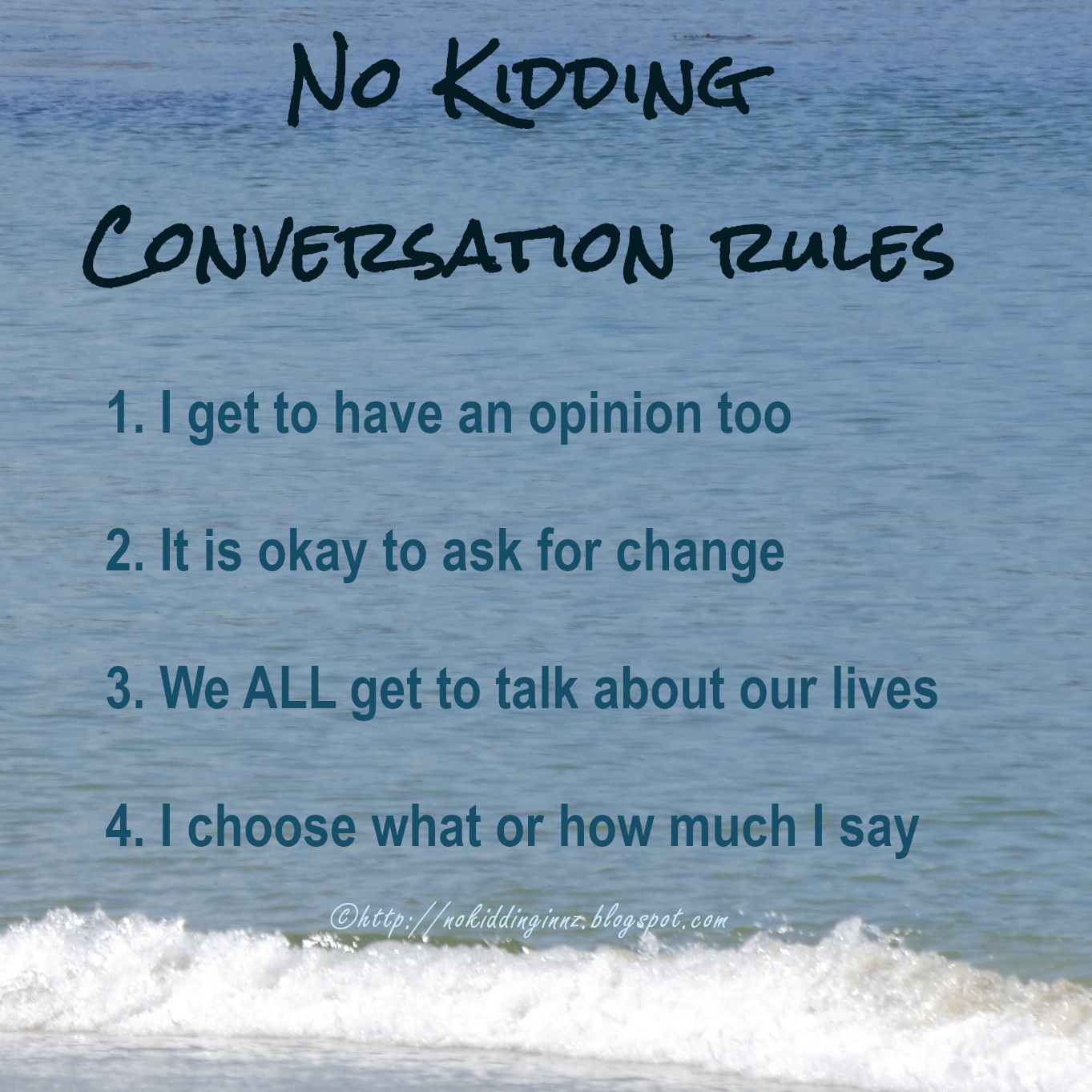
My No Kidding rules for conversation

How do we cope when our friends or family or colleagues do nothing but talk about their children or grandchildren? Even if we discuss something else, is this always where their conversations end up? Can we deal with that or not? I mean, conversations ebb and flow naturally. Some topics might be more relevant to us, and others might not be. But what do we do when the conversations always turn to the subject that excludes us? Do we have to just grin and bear it?

I’m going to start by saying I am lucky with most of my friends. There might be brief conversations about their kids or grandkids (though in the last few years, it has been more about ageing parents than adult kids), but ultimately, when we get together, there are other topics that dominate. We’d all always rather talk about work or books or movies or plays or politics or food/restaurants or movies or, best of all, travel! Even when I’m the minority (I have one particular group of friends that comprises three other women – with kids and (for two of them) grandkids – and me, without either), the conversation never dwells on the kids/grandkid issue. Other friends, who get together less often, are the same. I think it is simply a result of the interesting people who are my friends, rather than the fact that they are being especially considerate of me! They know I’m happy to talk about their kids, and if they don’t mention them, I will usually ask after them. But they don’t want to sit their and only talk about their kids. None of them want to be defined only as mothers or grandmothers. My hope is that you can all find at least one or two friends like that.

However, whilst I’m happy to sit and talk to friends about their kids/grandkids, it isn’t always the same in reverse. One on one, I don’t have a problem with most of my friends. We talk about my life without kids from time to time. But in groups, I’ve found that my particular No Kidding point of view gets shut down. At the very least, it has stopped conversation, and obviously made people uncomfortable. I’m not complaining about my life, either. Even though they’re free to complain about having kids/not seeing grandkids, etc. I’m just mentioning the reality of my life sometimes. They know me. They know my life. Why should that make them uncomfortable? It’s frustrating. But thankfully it is rare.

I have a few rules for when I’m talking with others. I don't always stick to them. But they're my baseline.

  1. If people are talking about kids, then I get to have an opinion too. I’m not going to criticise them as a parent (I don’t have a death wish! Lol), but I might have examples of other points of view, whether it is from observing friends and their kids, or experience with nieces and nephews, or my own experience as a child. Just because they’re talking about kids, doesn’t mean I have to sit the topic out. I’m there, I’m part of the group, I’m damn well going to be part of the conversation!

  2. If my input is consistently ignored or not welcome, then maybe I need to say something, or ask for change or consideration. Perhaps I’d throw it in lightly, in a jokey tone, along the lines of, “okay, enough conversation about your kids, let’s talk about the big wide world that’s out there waiting for them.” Perhaps on a more serious note, I’d point out (to one individually or to them all as a group) that they’re isolating me by always talking about their kids, and that they don’t seem to be interested in my life, or my participation in the group. I’d do it only when I feel strong, and when I’m prepared for the consequences. I’d like to add that I’d do it when I feel safe, but if friends are behaving that way, maybe I would never feel safe with them? And I’d do it tactfully, and avoid being overly aggressive or passive-aggressive. Fading away, or continuing to seethe, wouldn’t really work for me.

    After all, maybe they don’t even realise what they are doing, and how that makes us feel. Maybe they’ll make more of an effort. It’s possible. So perhaps it is worth the risk. Because of course, I know that speaking up is risky. We could be further isolated. Friends might start getting together without us, so that they can talk freely about their kids. That doesn’t make them very good friends, if you ask me. But our friends are our friends, and it can be hard to risk that. Still, it can be just as hard being in a group of friends who ignore our situation, who isolate us by constantly choosing topics of discussion that exclude us, and who, as a result, do tremendous damage to our feelings of comfort, self-worth, and safety amongst people who are supposed to love us.

  3. We ALL get to talk about our lives. If they get to talk about being parents, then I get to talk about being a non-parent. It is not a taboo subject! It’s also not a tit-for-tat situation. I won’t respond immediately to a story about their kids with my opposite situation. That’s not necessary. It just means that if I find I want to join a conversation, and my perspective includes a comment on not having kids – maybe I’m thinking about preparing for my old age, for example, or my environmental footprint – I can and will raise it as an issue. As I said above, I don’t need or want pity, and I’m not complaining. I’m just talking about my life.

  4.  I choose what I want to say. I’m not going to be shamed for my decisions, or goaded into saying more than I want to, just as I shouldn’t be shamed into silence. I therefore feel free to change the subject, or to let them see that invasive questions might be inappropriate.

Do you have any No Kidding conversational rules?