Showing posts with label isolation. Show all posts

28 October, 2025

Where do I belong?

Loribeth's post here, about a dream prompting questions about where she belongs, got me thinking. As she rightly said, many childless and perhaps even childfree people ask that question. 

I without doubt belong in New Zealand. Right now I belong in my city too, although my affections for it have plummeted these last few weeks, as our house has been battered with spring winds. I was caught thinking about where else I could live. I could move to the South Island where I have another sister and nieces and great-nephews, and one or two old friends. I have a fondness for that area. But my life has been very different, and so I don't think I belong there any more. There are other spots around the country that might be nice to live in, but where I might struggle to belong. A wealthy farming area has a charming wine village we love to visit but might be stifling to live in. Big cities can be thrilling but lonely. At one stage I belonged in Bangkok. I lived and worked there, loved being in an exciting environment, and felt very much at home amongst the Thais, even though I stuck out like a sore tall white thumb! But each time I return, I feel like I belong less and less. A friend has recently returned there, and feels that maybe she was trying to recapture a life that has passed. At one time we belonged, but do we still?

Even when I travel, I feel I belong - maybe as a tourist, rather than a local. But I'm not bothered by that. Sure, there might be some environments when I feel "out of place," but as long as I am engaged and exploring and enjoying myself, it's easy to feel comfortable, to feel as if I belong. Or perhaps I lie. Because when I travel too, on my own, I can feel terribly alone. Though I know it is possible to feel that without leaving home too.

But do I need to belong anywhere? I'm "at home" wherever I am if my husband is with me. We've been together for so long, he is my home. But I now know that's not going to be permanent. So I ask these questions anew. I think I prefer to belong to people rather than places. And that's the area I struggle. I need more people in my life. In the meantime, I have my sisters, nieces, and most importantly on a day to day basis, my friends who have also become my family. 

I remember after my ectopics and final resolution into a No Kidding life, I was desperate to travel and learn a language and spend time living somewhere else. I wanted to escape. I forgot, though, that I could not outrun my grief. I couldn't leave myself. My childlessness would follow me everywhere. 

I think maybe that's why we question where we belong. Because without children, we have always felt on the outside, as if we don't belong. Not in the way many parents feel they do - in their religions, schools, communities, and wider societies. We are always marginalised. I feel it less these days, as I mentioned here. But I still feel it. In all those places where parents feel validated, I feel othered. 

Belonging becomes something I've learned to do without. It doesn't mean I like it. But I've never quite thought about it this way before. As I read Loribeth's post, I jotted down my instinctive answer. I belong wherever I am. I belong in myself. Because that's who I need to survive. A healthy, contemplative, open and objective Mali with all her flaws. I take it all with me, and belonging comes with contentment, with acceptance, and with gratitude. I sometimes have to be reminded to find all those, but when prompted, it's possible. And then I can face the future. That's my answer. Wherever I am, I belong with me. Or perhaps, 

I am, therefore I belong.


09 July, 2024

More Otherhood Thoughts: Inspired by the library

It was great to see this week that our local library is offering unlimited downloads of Otherhood this week. And as a result, I also discovered that our library has a quite interesting blog! And in that blog* was an interview with the three editors. There were a few takeaways that I really liked, that sum up my view of No Kidding/Otherhood life, and that say what I want to say, just in a different way. 

The theme of the book really became, "what makes a fulfilling life?" And noted that the relationship between parent and child wasn't the "be all and end all." They were preaching to the choir on this one.

They wanted a diversity of experience, and got it, and I loved this part of the book. Because whether we wanted children or not, whether it was a deliberate choice or not, we are all affected by pronatalism, by judgement, and by condescension. 

Through the book, they've helped create a community, just as parents have an in-built community through prenatal classes or schools etc. They recognised that communities of No Kidding women already exist (like ours), but this is another option. I'm all for that. Not everyone is as lucky as I have been to find first my ectopic community, and then my blogging community. Community is, of course, especially important to those who otherwise feel isolated from society. As many as possible, please!

I had to laugh too when they noted that they have to restrain themselves (or not) when young people say, "I'm going to have two/three/four children." Or, "next year we intend to have a baby!" I have certainly been there. As two of the editors also experienced infertility, they know too well that such predictions might not come true, and hope that by talking about this more, young people can realise earlier that nothing is guaranteed.

They also noted they hoped the book and the interview might prompt people to think twice about the questions they ask. One encouraged parents to think about the most interesting thing you can talk about that is not about your kids/parenthood, etc. This is so overdue. "But it's natural for people to ask that," everyone (usually parents, or my don't-rock-the-boat husband) protests. It doesn't have to be. It's lazy, and it's a habit, is my response! And now I'm thinking about the most interesting thing I can talk about too. "Interesting" needs to be defined differently for each person. Travel, work, volunteering, retirement, food, etc etc.

As Lil (I think), pointed out, asking questions in a different way makes the diversity of stories throughout our lives more visible, and therefore not as isolating. I love this thought. My situation has certainly made me more aware of the many other diverse stories in society.

"Tell us about YOU, don't lead with your kids," they all implored. I second that. And should be writing it on my other blog. (I have, and it will be up next week.)

I was amused too that they said they tried to get our notoriously private former Prime Minister Helen Clark (also Not Kidding) to be involved with the book, but with no luck. "Phone me, Helen," said one, cheekily. She made me smile. But how great it might have been if someone with Helen's profile spoke out, in the same way that Jacinda once cringingly said, "not as a Prime Minister, but as a mother." However, I also understand her desire for privacy. It is no-one's business. And she was just as compassionate (and successful) a politician as any parent ever was.

Finally, they noted that the response so far has been wonderful, that so many people have found our stories meaningful. And that parents have been both supportive, but also have been curious. After all, just as their lives could have been ours, Otherhood is the story of the life that could have been led.


* Would you believe it? Between finding the blog and the interview, making detailed notes (thankfully) through the interview, and today, the library website has been "updated" and I can't find the interview anywhere. Argh.

06 May, 2024

Thoughts on my Otherhood

It's been a long time since I felt the need to read other people's experiences and say, "that's just how I feel." I needed that a lot when going through my ectopic pregnancies, and a lot too when going through the realisation and acceptance that I would never have children. I got plenty of satisfaction during the first example, and much less during the second. But there were at least a few people around in similar circumstances, and we would share our experiences and the Things People Said and for a moment, feel understood. Much later, when I began blogging and reading blogs (for over 13 years), I also found that comfort. But because I am older than most writing about this, and had already been writing about it (on messageboards etc) since 2001, it has been more of an exercise in personally putting words to what I think and believe and have learnt, and more importantly, sharing that knowledge, than the discovery and relief of finding I am not alone. Although knowing others understand is always, always, a bonus.

Yesterday, I had to take a selfie of me with Otherhood, the book (see Note below), and make a video reading a sentence (or two) from my essay. To do that, I'd watched the video of another contributor. Her sentences were ones we all know: 

"Just a note: never say to someone who is struggling to get pregnant, 'Have you thought about adoption?' Yes, they fucking have."  Kate Camp, in Otherhood: Essays on being childless, childfree, and child adjacent.

I grinned with delight. This was going to be good! For some reason, I'd been holding off reading the other essays. But Kate's sentence, her grin and glare in her video, set me off. I finally picked up my copy of Otherhood and started reading.

I laughed at the first essay I chose to read, by Kathryn van Beek, one of the editors. With humour and heartbreak, she ticked off so many issues I've talked about here over the years, and except one, that all the blogs I've read have mentioned too. She mentioned an experience I thought I alone had had. But of course, I wasn't the only one. And although I felt alone, I was not. It was the one mentioned in the first paragraph of this post. It was then that I realised anew the power of sharing experiences, of letting people know they're not alone, of knowing that there are others out there who understand. All this time later, over 20 years, I finally know that someone else saw those signs, and felt the same way I felt seeing them in the midst of losing a much-wanted pregnancy.

Since then, I've dived into other essays. In every essay I've read (only 4-5 so far), there has been at least one thing that has made me think, "that was (or is) me!" Including in at least one childfree essay. I'm resisting the urge not to mark the book, because I hate writing on books. I mentioned to my husband I think I need to buy another copy that I can write on or highlight! (He thought that was weird.) There is so much in it worth blogging about. I feel a renewed enthusiasm. I don't want to overwhelm you or push the book on you. But I definitely want to share some of the thoughts I have about it.

At the moment, I'm only reading the essays from my town, because we have our launch function on Wednesday. I want to meet those other authors, tell them what their essays mean to me, and share in an environment when, for once, I'm with my tribe in real life. But I'm so happy and grateful that I have my online tribe to share this with too.


Note: Links to buy can be found here, including for ebooks. Our editors advise that the print book will be available internationally from 8 August. Orders from overseas distributors come quite late and then the books have to be shipped via Melbourne, aggregated with other publishers’ books and then shipped to Chicago and London, hence the delay in availability. However, from May 9 people overseas will still be able to buy OTHERHOOD from NZ retailers, or from Massey Uni Press directly – they'll just have to pay international shipping fees.


28 August, 2023

No Kidding absences

 A friend was telling me about a colleague's wife she goes walking with. The colleague and his wife are much older, and starting to think about where they will spend their final years. They have children, but they all live in other countries, at least one long haul flight away, so the parents know they need to sort things out themselves. 

As my friend (also Not Kidding) said to me, "so much for having kids to look after you in your old age." And yes, we laughed. 

I've just heard a man on the "Proud Parents" section on a radio show I listen to regularly. I roll my eyes a little at the name of the section, and the existence for it, but although I've only heard it twice, each time it has been a proud father talking about daughters, daughters who live on the other side of the world. You can hear that they miss having their children near them. 

Still, if those parents needed their children, you can be pretty sure they would be on the first flight home. And the elderly couple can delay making a decision about where to live, because they have the back up of their children, even though they are far flung. They want to leave the decision until they "have to," but don't realise that that will be too late. When you "have to" move, it means you're not capable of staying in your existing accommodation. Which means that you also may not be capable of organising or making the move itself. They have people who can help. We don't.

I'm not sure even parents with children who live far away ever understand quite how isolated and alone many of us feel. Sure, they feel the absence of the children in their lives, and that must be very hard. But do they understand the finality of the absences we feel? I wonder. 

Well ... that took a gloomy detour from what I had originally intended to write. Which was simply that we may have more in common with some parents than we realise. Except, of course, that too often, we don't.


01 May, 2023

The importance of connection as we age

Loribeth highlighted this article about the importance of networks as we age. (She’s so good at telling us about articles that make me think). This is, of course, particularly important for those of us who do not have children (or for those whose children do not live nearby or are estranged or busy etc), to ensure that we have ongoing connections in our lives. But it is also something we are, as a community, quite good at, precisely because we haven’t had children we rely on to provide comfort and assistance.

It noted that the pandemic was particularly hard on elderly people, who lost that face-to-face, day-to-day contact with a range of people that aids our well-being, whether it be the cheerful person making our coffee, or the packer at the supermarket who is always helpful, or the people at the gym or exercise class who chat as we change. Poor health also affects people of all ages getting out and about making human connections. Lacking those day-to-day interactions can be awfully isolating. Especially if we already feel isolated because we don't have children. Just seeing change in our local environments can feel isolating. Our local Post Shop (post office and small store) is closing. I never knew the two who run it really, but they knew me, and I knew them, over 20-30 years. Likewise, we miss our favourite brunch place, and the two men who owned and managed it. We had our regular chats, exchange of travel information, and gripes about silly people. They were part of our network, and I miss them.

Online friendships were acknowledged in the article, and I’m really glad about that. We’ve come a long way in the last 15-20 years! I remember back then hearing a contemporary of mine scoffing at the idea that people look for support online. “That’s just sad, isn’t it?” she said disbelievingly. I was appalled at her naivety. I knew from personal experience that internet friendships can be real, close, supportive relationships that can provide more support and nurturing than our real life relationships. They are an important way we connect with others, and are vital for our well-being if we can’t get out and meet others who share our experiences. Yet we also all know that they can’t pop over to help out if you’re sick, or meet for a coffee or a drink, or give you a hug if you are sad. And we can't give love in that way either. We’ve all said it on each other’s blogs or in messageboards or whatsapp or fbk groups etc etc. “If only we could be there to give you a hug!” And every time I say it, I mean it.

The article then mentioned a woman who started a group of “elder orphans” – people who don’t have spouses or children to depend on. Though I have a spouse, neither of us have younger relatives we are close to in this city. (There’s one – a cousin’s niece, but we don’t really know her). And if one of us isn’t here, then whichever of us is left will definitely be an elder orphan. I love this idea of forming a group. Social media makes it so easy to do these days. We can connect with people in the same locations, as well as online. I’m definitely going to bear it in mind.

I know I’ve written a lot of this before, though in slightly different contexts. I think I write these posts as much as a reminder for me to get out and about, as I do for you. Because I suspect you are all already better at this than I am! Being self-employed since my 40s hasn’t really helped me forge new relationships. Although it has helped me nurture the ones that might have disappeared. And I have plans – I just haven’t joined that photography group yet, or another book club, or found somewhere to volunteer (because I can’t commit to doing something weekly if I’m going to be travelling two months in, etc). But they’re all on my list of things to do sometime this year, or next! Anyone have any hints on how you make and keep connections?

23 May, 2022

Being an aunt

 A week or so, Loribeth alerted her readers to an article written by Yael Wolfe, titled I'm Retiring from Aunthood. She is a No Kidding author talks about her love for her nieces and nephews, and all the help she gave her siblings with their children. "Nothing was more important to me than those kids," she writes. She notes, almost as an aside, that the help was often one-sided, and that she didn't get the same degree of support and assistance from her family (except occasionally from her brother) that her siblings with children received.

She is writing the article on Mother's Day, feeling left out and unwanted, and sad that no-one cares about aunts. "I think we should care about aunts."  

The article is devastating. I hear the yearning that she feels for these children she loves, and for the role she played in their lives ("Second Mommy" for one of the children). I feel her loneliness that she now only sees her nieces and nephews a few times a year, when she used to see them a few times a week. I feel that too, when we are so far away from all my nieces and nephews and great-nephews - the closest is a seven-hour drive, and the furthest is on the east coast of the US. The Husband actually said to me the other day, as we were admiring photos of little great-nephews growing up in Western Australia, that we are very isolated from our families. It can be lonely.

I feel too the lack of acknowledgement she gets from not just the kids, but from her siblings, who have benefited from her love for her nieces/nephews, but are it seems completely oblivious. They are the ones who are at fault. Are they so focused on their family that they don't consider their sister, and let her know how much she will be missed? 

Also, the focus only on the nuclear family, rather than all who contribute to the lives of the children, damages not only those who are excluded, but it is damaging for the children. They might grow to see people as replaceable or unimportant or learn to take them for granted. The sadness they might feel at losing their aunt (in terms of time and physical presence) might be dismissed by the parents, and not fully acknowledged, teaching a child that their feelings don't matter.

The author quotes her nephew who, when she shared how sad she is that they are leaving, "just shrugs and says, “We just need some new adventures.”"  She is tremendously hurt by this. Though, without knowing how old he was, I wonder if he was parroting his parents. Maybe he expressed sadness or hesitancy about moving, about leaving his school and friends and yes, about his aunt, and his parents said, "we need some new adventures" to explain the move. Perhaps he is very sad, but not really allowed to express that? We won't really know, but it is a reminder that when we are feeling very hurt, we focus on that, rather than on the other possibilities. I think it is a reminder too that as aunts, we are the adults, and we can't really put our feelings before the children. For that reason, I wouldn't want to retire from aunthood, however hurt I am, or however distant (in geographical terms) I might be. Stepping back a little is fine, but I know I've always wanted my nieces (in particular, a couple with whom I've had closer relationships) and nephews/great-nephews to know that I'm here for them if they need me.

Of course, I'm not saying that she can't grieve the loss of these families and the children in her day-to-day life. It is a real loss, and one that I suspect will not be acknowledged by anyone except her No Kidding friends. It's one we understand, and for many of us, feel deeply.

I do hope that the children will always feel a closeness with her, established as it was at such a young age, and I hope that the children I've been close to will always feel that too. Writing this reminded me to text my 14-year-old niece, asking if she had received my birthday present. I've been irritated, for about a month off and on, that neither my sister (her mother) or my niece had let me know, despite me telling them when to look out for the mailbox. We were taught when we were young to send thank you notes. Thank you texts are so much easier, you'd think, but it seems not. Still, I had a lovely exchange with her, she confirmed receipt of the gift and was very grateful, we chatted about books, and she's promised to tell me what a particular book was like when she's finished it. She'll probably forget! I am not just secondary in her life, but come well down the list, simply because I see her only a few times a year. But I hope that these little exchanges remind her that she is loved, just as my exchanges with my adult nieces in Australia remind them I'm part of their lives, and that I love them. They start to drift away in their teens, but I think when they're adults they might come back to us - even if they don't communicate as often as we would like! And as older teenagers and adults, we develop independent relationships with them, separate from our relationships with their parents. That can be a real bonus! I think too that as adults they start to appreciate who we are, and our places in their lives, that they didn't, or couldn't, when they were younger.

Aunthood is complicated, and even more so when we don't have our own children. As children I've know have drifted away, or moved physically, I've decided to cherish the experiences I had with them, to value that time, and to understand that it had real value to them and/or their parents too. It taught them so much - that lives are different, that people other than your parents can love you, nurture you, teach you, laugh with you. If it hasn't continued, or if it changes, it doesn't negate the special parts we played in each others' lives. I think that's really important. To recognise that it was good, and to appreciate that.

09 May, 2022

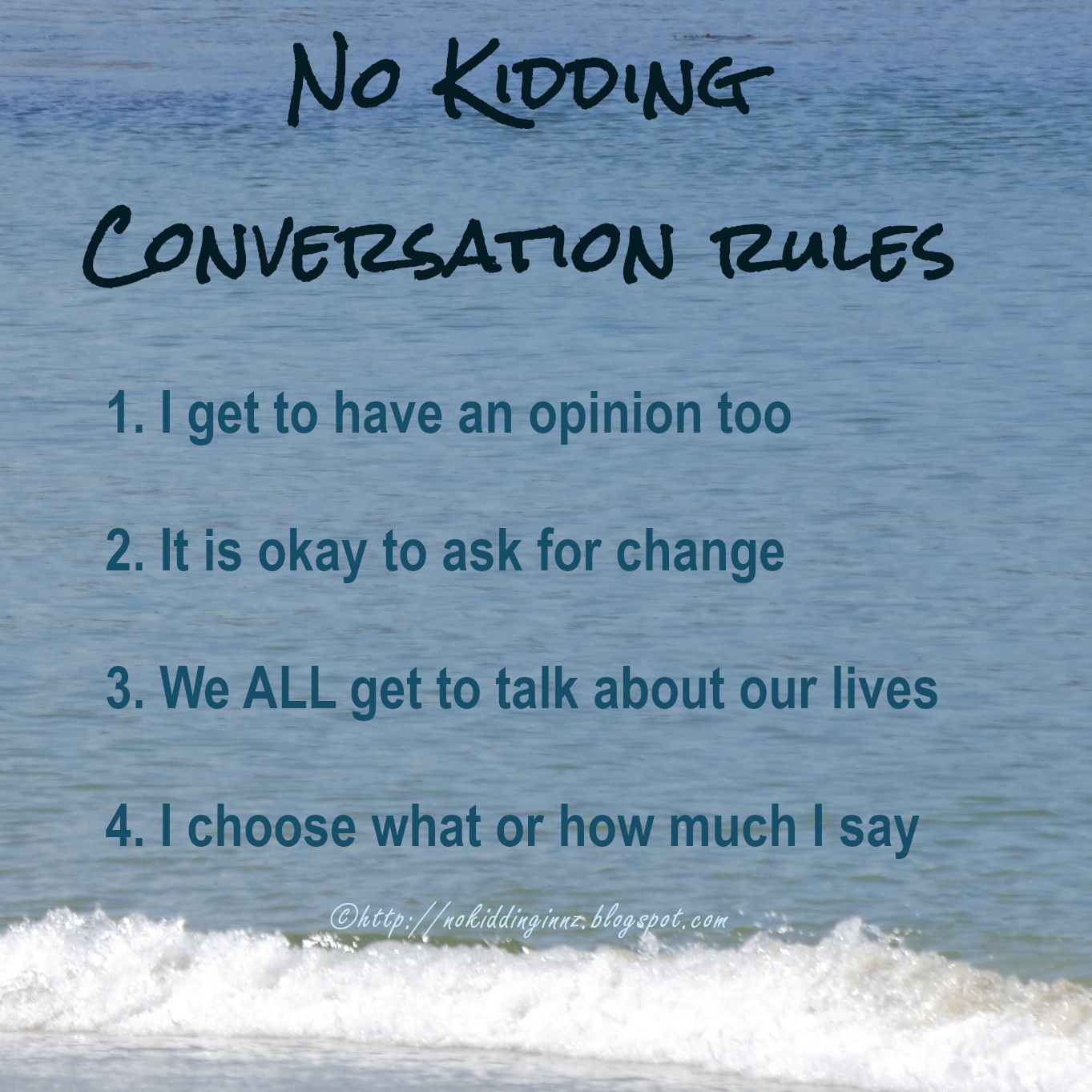
My No Kidding rules for conversation

How do we cope when our friends or family or colleagues do nothing but talk about their children or grandchildren? Even if we discuss something else, is this always where their conversations end up? Can we deal with that or not? I mean, conversations ebb and flow naturally. Some topics might be more relevant to us, and others might not be. But what do we do when the conversations always turn to the subject that excludes us? Do we have to just grin and bear it?

I’m going to start by saying I am lucky with most of my friends. There might be brief conversations about their kids or grandkids (though in the last few years, it has been more about ageing parents than adult kids), but ultimately, when we get together, there are other topics that dominate. We’d all always rather talk about work or books or movies or plays or politics or food/restaurants or movies or, best of all, travel! Even when I’m the minority (I have one particular group of friends that comprises three other women – with kids and (for two of them) grandkids – and me, without either), the conversation never dwells on the kids/grandkid issue. Other friends, who get together less often, are the same. I think it is simply a result of the interesting people who are my friends, rather than the fact that they are being especially considerate of me! They know I’m happy to talk about their kids, and if they don’t mention them, I will usually ask after them. But they don’t want to sit their and only talk about their kids. None of them want to be defined only as mothers or grandmothers. My hope is that you can all find at least one or two friends like that.

However, whilst I’m happy to sit and talk to friends about their kids/grandkids, it isn’t always the same in reverse. One on one, I don’t have a problem with most of my friends. We talk about my life without kids from time to time. But in groups, I’ve found that my particular No Kidding point of view gets shut down. At the very least, it has stopped conversation, and obviously made people uncomfortable. I’m not complaining about my life, either. Even though they’re free to complain about having kids/not seeing grandkids, etc. I’m just mentioning the reality of my life sometimes. They know me. They know my life. Why should that make them uncomfortable? It’s frustrating. But thankfully it is rare.

I have a few rules for when I’m talking with others. I don't always stick to them. But they're my baseline.

  1. If people are talking about kids, then I get to have an opinion too. I’m not going to criticise them as a parent (I don’t have a death wish! Lol), but I might have examples of other points of view, whether it is from observing friends and their kids, or experience with nieces and nephews, or my own experience as a child. Just because they’re talking about kids, doesn’t mean I have to sit the topic out. I’m there, I’m part of the group, I’m damn well going to be part of the conversation!

  2. If my input is consistently ignored or not welcome, then maybe I need to say something, or ask for change or consideration. Perhaps I’d throw it in lightly, in a jokey tone, along the lines of, “okay, enough conversation about your kids, let’s talk about the big wide world that’s out there waiting for them.” Perhaps on a more serious note, I’d point out (to one individually or to them all as a group) that they’re isolating me by always talking about their kids, and that they don’t seem to be interested in my life, or my participation in the group. I’d do it only when I feel strong, and when I’m prepared for the consequences. I’d like to add that I’d do it when I feel safe, but if friends are behaving that way, maybe I would never feel safe with them? And I’d do it tactfully, and avoid being overly aggressive or passive-aggressive. Fading away, or continuing to seethe, wouldn’t really work for me.

    After all, maybe they don’t even realise what they are doing, and how that makes us feel. Maybe they’ll make more of an effort. It’s possible. So perhaps it is worth the risk. Because of course, I know that speaking up is risky. We could be further isolated. Friends might start getting together without us, so that they can talk freely about their kids. That doesn’t make them very good friends, if you ask me. But our friends are our friends, and it can be hard to risk that. Still, it can be just as hard being in a group of friends who ignore our situation, who isolate us by constantly choosing topics of discussion that exclude us, and who, as a result, do tremendous damage to our feelings of comfort, self-worth, and safety amongst people who are supposed to love us.

  3. We ALL get to talk about our lives. If they get to talk about being parents, then I get to talk about being a non-parent. It is not a taboo subject! It’s also not a tit-for-tat situation. I won’t respond immediately to a story about their kids with my opposite situation. That’s not necessary. It just means that if I find I want to join a conversation, and my perspective includes a comment on not having kids – maybe I’m thinking about preparing for my old age, for example, or my environmental footprint – I can and will raise it as an issue. As I said above, I don’t need or want pity, and I’m not complaining. I’m just talking about my life.

  4.  I choose what I want to say. I’m not going to be shamed for my decisions, or goaded into saying more than I want to, just as I shouldn’t be shamed into silence. I therefore feel free to change the subject, or to let them see that invasive questions might be inappropriate.

Do you have any No Kidding conversational rules?


11 April, 2022

Covid Isolation and Childlessness

My sister-in-law in Perth (Australia) was complaining last night to me about the lengthy isolation periods she and all her friends were going through, as each of their kids get covid (because that's what university/high school age offspring do) in succession, every few weeks. Two of her kids have had covid over the last two months, and she is expecting more time spent in isolation as her youngest, and then she and her husband, inevitably (as far as she is concerned) get covid. (For those who don't know, Western Australia has been much like NZ, covid-free with life as normal for the majority of the pandemic so far, but omicron was their undoing, as it was ours.) She was telling me about all the meals her friends were dropping off to her because she had been sick (not covid this time), and said they had all been doing that for the last few months through these isolations.

I had two reactions. The first was one of, ironically, isolation. We only have a few friends who live close to us, so there wouldn't be a lot of food drop-offs if we get sick, or vice versa. Whereas her network comes from the friends they made through all their children and their various schools, so they are all linked, and centred around a similar location (the schools) too.

My second reaction was smugness. If DH gets covid, I'm very likely to get it, and vice versa. We'll have to isolate then, but that's it. No lengthy or multiple inconveniences brought home by kids. I shared my smugness with her. That's when the conversation ended! 


07 March, 2022

"Do you have children?" - how parents might react

Further to my post last week, this week I want to talk about the perspective of parents, both in asking this question, and their reactions to it.

From the perspective of the majority, the people who have children, the question* “do you have children?” seems perfectly reasonable. For them, it is an easy topic of conversation, an easy way for them to find things in common to talk about, with lots of follow-up questions (how old, what schools, etc). It breaks the ice, and allows people to bond quickly when they don’t know anything about each other. “What’s wrong with that?” they think, not allowing themselves to answer their own question. So I'll answer it for them.

When we do have a conversation with strangers, rather than ask the question bluntly, some throw in a casual comment or comments about their children that are often a seemingly natural part of conversation. This is perfectly natural – we talk about what we know. But it also might be that these comments are in fact a fishing expedition, a call-and-response process. Those making them might mention something as an aside, but they are also often testing the waters to see if there is a response that tells them whether they can continue to this line of discussion. It tells them whether they can delve further into the world of parenting and kids or not. I’m actually fine with this approach. It allows parents to choose whether or not they want to volunteer information about their children. And it is a much more subtle way of asking “the question,” and one which doesn’t require a direct response. It is more sensitive, and less intrusive, and allows me to show interest in their lives, without throwing myself into a whole “I have kids too” type of conversation.

We all follow this “fishing” technique in multiple ways – talking about work, or seeing if there is an interest in travel or sport or even politics or reading or gardening or any other topics of conversation – without directly broaching the issue which might cause conflict or make someone feel awkward. I, for example, am careful about talking about travel with people I don’t know (and people I do know) … though not so much on my blogs! I’m conscious that there are people who would love to travel, but can’t because of financial issues, fear of flying, child or parental care issues, health issues, work issues, partners who refuse to travel, nervousness, those who can’t travel because they don’t want to travel alone, or those who just aren’t interested! And so I take my cues from others. Just as anyone, casting out small comments about an issue to see if anyone takes a bite, needs to watch for those bites or their absence. Their absence is just as informative as a confirmation. People who are fishing like this need to read* the room, as do the others in the conversation. We all need to be aware.

To state the obvious, in a conversation amongst adults who have just met each other, if someone does not respond to a comment or several separate comments about children, or responds referring to their niece(s) or nephew(s), there is probably a very good reason for it. If anyone is not volunteering information about their children or nonchildren, then they are clearly not wanting to bring up the issue in that group. At that point, a tactful conversation can easily and gently continue in other directions, without making anyone feel awkward. It doesn’t even have to go as far as making anyone feel very awkward.

I’ve heard it suggested that asking "the question" allows shy parents to join in on the conversation, when otherwise they might feel excluded. In my observations, however, parents don’t generally hang back from mentioning their children, unless they don’t want to, and it is common for parents (even shy ones) to say, “mine too” or offer some other anecdote about their children, simply to establish a mutuality of experience, show that they understand, or that they are part of the club too, or to invite other conversation about kids. It’s an issue of where is the most or least harm. Parents who are shy about joining a conversation are rarely going to feel as excluded as those of us without children when asked a pointed question.

But those of us who are childless or childfree are not the only ones who might bristle at being asked this question, or feel excluded in a conversation. 

  • Perhaps they are trying to have them and struggling? 
  • Perhaps they have lost a child or pregnancy
  • Perhaps they just don't want to talk about their kids that particular day
  • Maybe they have special needs kids and so can’t join in on parts of the conversation and don't want to go through the explanation yet again
  • Maybe they have a difficult relationship with their children. 
  • Or perhaps they've just had a terrible day and need a break 
  • What if their children are really struggling at the time?
  • What if their kids have behavioural difficulties?
  • What if their kids are diabolical teenagers at the moment/the last two years? 
  • Let's not even touch on the conversations amongst women about vaginal births, breastfeeding etc which can isolate those with C-sections, adoptive parents, those who used surrogates, couldn’t breastfeed, etc.
  • Maybe parents don't feel comfortable sharing anything about their children to strangers
  • Some parents just don’t always want to talk about their kids all the time.
  • Maybe a mother is sick of being categorised as a mother before everything else. 
  • Maybe they want to be seen as a person in their own right at a particular event or in a business context
  • Maybe they're my SIL, who told me how a colleague used to discuss business or clients with her when they were on the same train commuting home, until she had her first child. Then she was only asked about her child, even though she was a new partner at their law firm. She was put in a box, and was not treated as an equal. It infuriated her.
  • Maybe parents go out to meet new people as an escape or break from parenting?
  • Maybe not every parent is ecstatic about their parenthood
  • Perhaps they don't want to be identified as a parent
  • Perhaps they lost custody of their children
I’m sure there are many other reasons why some parents might not want to be invited into a conversation about their children.

It’s a question, then, that people ask from a place of privilege. Not just the privilege of being parents, but of being parents who are happy to talk about their kids, to share with others the fun stories, or the details of where they go to school, or play sports, or how well they’re doing at university or in their chosen careers. I really wish parents would think about that. After all, they might be more compassionate to their fellow parents than they are to the No Kidding!

Of course, having said that, I do have to acknowledge that parents might be so busy parenting that there is little else that they think about, or even have the capacity to think about. When parenting is so all-encompassing, they may feel uncomfortable in discussions about other issues - they don't have time or energy to travel, or read the latest news or listen to music or watch the latest Netflix shows or see plays or play sports or eat out. Maybe they don't work, or work is just a means to an end. I understand that. And I could talk about that with them, or even about what they wished they had time to do/see/read etc. It's not as if I am totally against discussions about children. Of course, although I'm especially interested in my friends' children, I'm happy to hear about other people's kids. But not to the exclusion of all else.

So my point is that it should never be a one-sided conversation, ignoring those who can't or who are uncomfortable participating. Conversations should be an exploration of experiences, views, commonalities, information. They should invite people in rather than leave people out.  Some questions don't do that. "Do you have children?" might be one of them.

* Yes, I know, I’m in danger of mixing metaphors, and I hope this is not too obscure for my English as a Second Language readers. 


28 February, 2022

“Do you have children?” – how this question affects me

I have been thinking about “the question” again after some recent events. I’m going to write another post, a follow-up to this, as I’ve been forced to split a long post into two! And I’m starting with what I had thought would be the end of this post. I'm starting with my how it makes me feel, and the thought process I go through as I answer it. I’ll be interested to know if you feel the same way, and go through the same thoughts. Please share your experiences with me, so I know I’m not the only one.

The problem with the question “do you have children?” is that it, and the answer which I am then forced to give, singles me out as “other” in a way most other questions do not. Whenever I am asked this question, I tense, internally at least, but probably physically too. My mind races. In a split second, I have all these thoughts:

  • What do I say?
  • Do I make a joke? 
  • Do I answer rudely? 
  • Do I have to tell them? 
  • Why?
  • Do I go into any detail? 
  • If so, how much? 
  • Do I look sad, or happy? 
  • How are they going to react? 
  • Are they going to be like some people who have literally turned their backs on me when they hear my answer? 
  • Will they still want to talk to me?
  • Or are they going to show that they have no interest in taking a conversation or budding relationship any further? 
  • Are they judging me?
  • Are they going to say “as a mother” or “you wouldn’t understand” or “why didn’t you adopt?” or any of the other tiresome, inaccurate, and sometimes offensive clichés? 
  • Do I need to prepare myself for that? 
  • Do I have any smart answers for them? 
  • If not, why not?
  • And, isn’t it time I got some?! 
  • Am I going to find myself in a group of people who then go on to ignore me? 
  • Will I need to find a tactful way to remove myself from the conversation and find some other people to talk to? 
  • Will that even be possible? 
  • Do I look obviously surprised?
  • Am I doing an impersonation of a stunned mullet?
  • Have I been thinking these things for too long? 
  • What am I going to I say again?

But however I respond, I'm always truthful, and my answer almost always marks me as “other.” So I always, always brace myself when I’m asked this question (or when I am wished Happy Mother’s Day, etc).

I don’t think it is a case of me being oversensitive. 20 years on, the answer is no longer raw, and it is not going to spark tears, or ruin my day. I can brush off the question (although very obviously I analyse my reactions and the motivations behind the question itself later) and continue a pleasant conversation with otherwise interesting people. (If the question is followed up with “Why not?” then that complicates matters. There’s a whole different string of thoughts when I am asked that question.) But when I tense myself on hearing the question, and go through all those options for replying, what I am really doing is remembering previous, difficult moments, and hoping to avoid them this time. Inevitably, I also worry if I am being cowardly in my answers, if I’m going to say too much or too little, and wonder if I am adequately representing the valued No Kidding community. It's never a simple question, with a simple answer.

Unfortunately, we rarely get to explain this to interested friends or family. Sometimes, even the best struggle to understand. They don’t really want to listen to my discomfort over the question. They might become defensive about their own situation, or maybe they want to defend others who are also in the parent club. It becomes about their discomfort, thinking about how they have talked about their children. They forget that this started when we tried to explain how the question makes me or other No Kidding people feel, and make it about them. They make excuses, give reasons.* They try to convince us that it is our problem, without really listening. 

Sadly, the feelings and position of those of us without children (for whatever reason) are often made secondary. We're used to that, of course. The fact that the majority so easily ignores us seems to be accepted, or excused, by that same majority. Might is right. Or not, in this case.

* In my next post, I'll talk about the excuses and reasons given by parents for why "the question" is perfectly reasonable, and my thoughts about them.